 Solidly
 links token swaps with vote-directed liquidity incentives
Solidly began as Andre Cronje's decentralized exchange on Fantom in February 2022, combining token swaps with vote-directed liquidity incentives. Its original automated market maker (AMM) supported stable and volatile pools. Locked SOLID tokens gave holders voting power over liquidity rewards. A later team continued the project through an Ethereum fork and migration, followed by V3 concentrated liquidity. Later deployments have chain-specific pools, positions and rewards.
· updatedFrom Fantom launch to an Ethereum continuation
Andre Cronje launched the original exchange on Fantom in February 2022. That V1 design combined permissionless liquidity pools with governance positions represented by non-fungible tokens, known as veNFTs. Traders exchanged assets against reserves that liquidity providers (LPs) supplied, while voters influenced the distribution of token incentives. Trading demand generated fees, while voting shaped where emissions supported liquidity.
A subsequent team forked the project and continued it on Ethereum through a token migration from the original Fantom deployment. Later versions developed the exchange further, including V3 concentrated liquidity. Rewards, position types and network support differ between the original Fantom contracts and the later platform.
How do stable, volatile and concentrated pools differ?
Stable and volatile pools use different reserve curves, while V3 lets providers concentrate liquidity within selected price ranges.
Volatile pools
A volatile pool accommodates assets whose prices do not need to track one another. Its constant-product relationship is
x × y ≥ k
, where x and y represent the pool's reserve quantities and k is the invariant benchmark. A trade changes the reserve balance, which changes the next quoted exchange rate. Trade size relative to available reserves therefore matters even when the pool type matches the assets.
Stable pools
The stable curve targets assets expected to trade close to one another in value. The V2 expression is
x³y + y³x ≥ k
, using reserve quantities in the curve's normalized units. This produces a different trading profile around the intended price relationship, which remains an assumption about the assets. The curve does not prevent a correlated pair from diverging in market value.
V3 price ranges
V3 adds concentrated liquidity, allowing each provider to choose where capital sits along the price curve. More liquidity near the traded price can reduce slippage for the swaps that use it. The effect depends on how much active liquidity covers the trade. A position outside its selected range does not supply active liquidity at that price.
What does veNFT voting change for liquidity rewards?
veNFT voting directed SOLID emissions toward pool gauges in the original V1 design, giving locked-token holders influence over where liquidity incentives flowed.
Locks and emission allocation
The original V1 system allocated weekly SOLID emissions among gauges using veNFT voting weights. A gauge was the contract that distributed rewards to participating liquidity providers. The voting position and the LP position served different purposes. Locking SOLID supported voting rights; supplying a pool supported trades. A vote influenced incentive allocation without establishing that the pool's trading volume or asset value would increase.
Trading fees and voting incentives
V1 also supported voting incentives, commonly called bribes. Participants who voted could claim the applicable rewards through those contracts. Gauges could forward their accumulated pool-fee share to the voting-incentive contracts for voter rewards. V3 separates liquidity rewards from voter rewards. Its LP rewards include trading fees, SOLID emissions and LP bribes. Voter rewards have their own fee and bribe accounting.
Trading and participation choices across versions
Swaps, liquidity deposits and governance positions involve different parts of the exchange. The version matters because a V1 gauge deposit is a separate reward mechanism from supplying a V3 price range. The V1 entries concern the original Fantom design; V2 and V3 concern the later continuation. Availability follows the particular deployment and its pools.
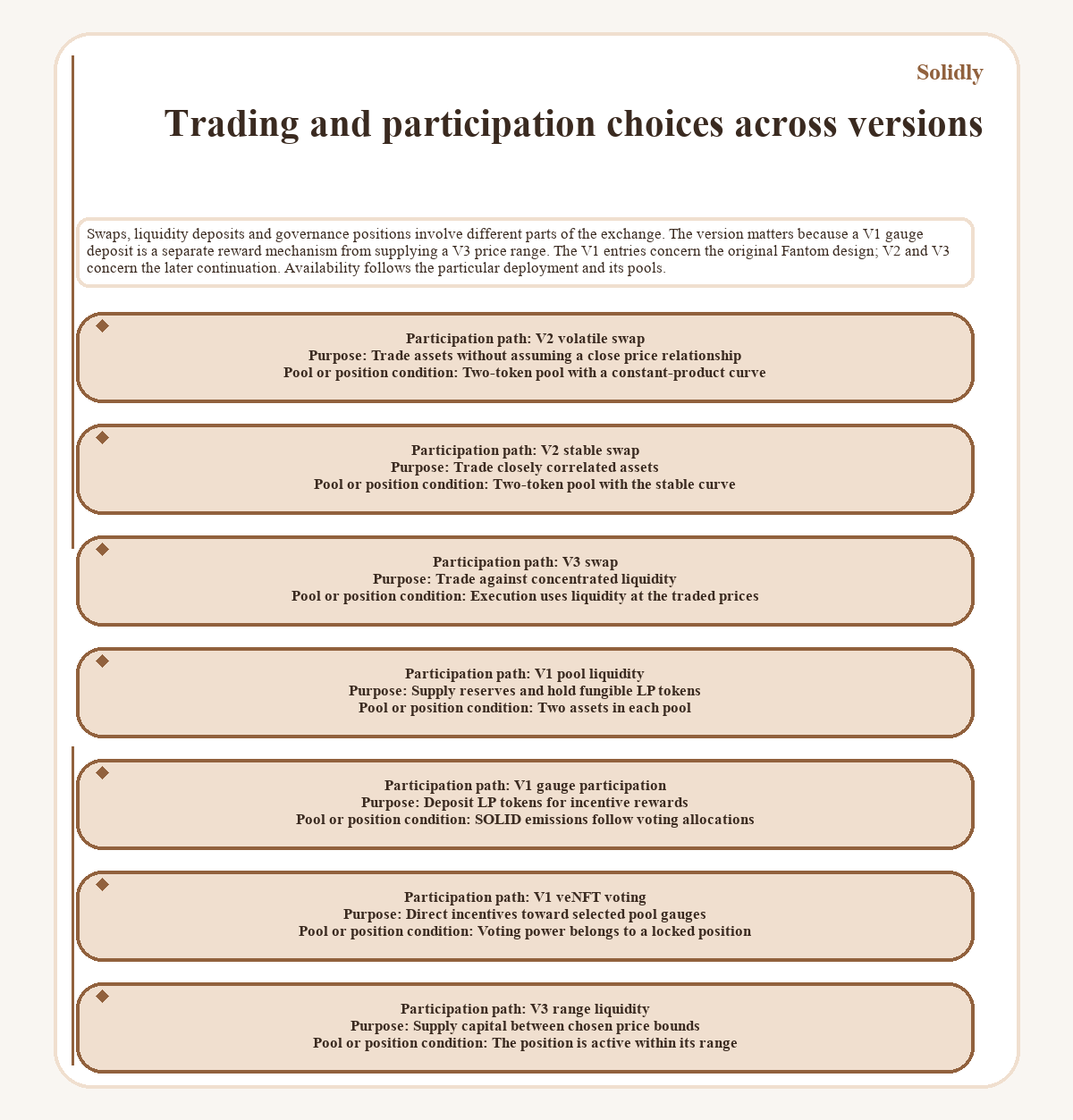
| Participation path | Purpose | Pool or position condition |
|---|---|---|
| V2 volatile swap | Trade assets without assuming a close price relationship | Two-token pool with a constant-product curve |
| V2 stable swap | Trade closely correlated assets | Two-token pool with the stable curve |
| V3 swap | Trade against concentrated liquidity | Execution uses liquidity at the traded prices |
| V1 pool liquidity | Supply reserves and hold fungible LP tokens | Two assets in each pool |
| V1 gauge participation | Deposit LP tokens for incentive rewards | SOLID emissions follow voting allocations |
| V1 veNFT voting | Direct incentives toward selected pool gauges | Voting power belongs to a locked position |
| V3 range liquidity | Supply capital between chosen price bounds | The position is active within its range |
Chain-specific pools and position tools
The later Solidly platform covers Ethereum, Optimism, Arbitrum, Base, Fantom and Sonic. Each network has its own pools, rewards and contract addresses; the wallet menu identifies the connected chain. A pool or balance shown for that network belongs to that deployment, even when a matching token symbol appears elsewhere.
Pool and position tables support monitoring. Access to rebalancing is rolling out by wallet; where enabled, it can recenter a position around the current price. The Rewards page provides a separate interface for claims. Claiming collects the rewards that the position has earned.
V3 rewards use off-chain calculations that the system publishes on-chain as a Merkle root. A claim supplies a proof against that distribution on the chain that generated the rewards. A balance awaiting synchronization is pending, and a newly published root also passes through a security buffer before claiming opens.
Position-watch notifications provide browser and Telegram alerts, while the mobile interface adapts its tables for a smaller screen.
Pool labels and token figures need context
A swap quote reflects the chosen assets, route and available liquidity. Pool fees and network transaction costs affect the economics separately from the curve. In V1, the router could chain swaps through both stable and volatile pairs. A direct pair was therefore not the only supported routing pattern. The selected path changes which reserves the trade uses, so a pool label alone cannot establish the final output or total cost.
The historical Ethereum migration also produced supply figures tied to that transition. Locked tokens, floating supply and the remaining mining allocation measured different things. A migration-era balance should not become a claim about today's circulating supply. The tokenomics for the Ethereum continuation described a total cap of 100,000,000 SOLID.
Answers to common questions
-
Was V1 pool creation restricted to approved projects?
- V1 pool creation was permissionless and did not require membership in an approved project list. The factory created a pool from two token addresses and a stable-or-volatile choice. Creating that pool was separate from attracting liquidity or receiving vote-directed incentives. Permissionless deployment also meant that a pool's existence did not certify the assets that it contained.
-
Where were V1 trading fees kept?
- V1 kept trading fees in a separate BaseV1Fees contract associated with its BaseV1Pair pool. Each pair had its own fee contract. Fees did not automatically become extra reserves in the trading pool. An accrued fee balance was separate from the underlying liquidity balance.
-
Could a V1 liquidity provider earn rewards without a ve-token balance?
- V1 allowed gauge rewards for liquidity providers who had no ve-token balance. Voting-escrow ownership affected the boost that determined a provider's effective reward weight. The pool's incentive allocation and the provider's participation still affected earnings.
-
Can a wallet hold separate V1 voting locks?
- A V1 wallet could hold separate veNFT locks, each identified by its own tokenId. The voting interface read a lock's voting balance through balanceOfNFT. A wallet address identified the owner, while the NFT identified the governance position and its associated locked SOLID.
-
Is the historical Fantom-to-Ethereum migration still open?
- The migration window for the original Fantom-to-Ethereum transition has closed. That migration honored a 1:1 move from the V1 deployment to the refactored Ethereum platform. The ratio describes the historical token transition and does not establish an available swap route between later deployments.
-
Does Solidly V3 use Uniswap V3's concentrated-liquidity design?
- Solidly V3's AMM derives from a fork of Uniswap V3. The shared foundation explains its range-based liquidity model. The implementation includes protocol-specific changes, so code ancestry does not establish identical contracts, gas costs or reward rules.